Podcast Episode 5 – At the Kitchen Table with Paul Heath

This podcast is a way to share stories from families we support and our family advisor partners. These stories share a common theme – a critique of the idea that to be wealthy is not just about how much money you have but how you put your family’s resources to use for future generations.

I partner with Koda Capital to deliver leadership and inter-generational wealth for families and have worked with the Koda CEO Paul Heath for over 10 years. In this episode I sat down with Paul to talk about the value of independent financial advice and how the industry will transform over the next 10 years. I particularly enjoyed hearing how families have created stewardship. The successes and the failures.

Paul has a significant amount of experience and the lessons he shares from these families are really insightful.

Listen to the episode below:


Lead with Confidence

When I coach business leaders, I am often asked to inject some confidence into the person I am coaching. It is not uncommon for a new Executive to have a broad goal of ‘confidence’ as they transition and find their feet.

Of course, confidence is not limited to how you carry yourself in the workplace. Quite often our role guiding the conversation in a family is to give specific family members the space and room to voice their opinions when they otherwise lack the confidence to make their point of view heard. The philosophy that shapes our work with families is that we want to create confident stewards.

So, what does confidence look like and how can you be more confident in the interactions with your family? Here are three important places to start.

Consider how you prepare and carry yourself

  • Be mindful. Take time out before an important family meeting or engagement to create a positive state of mind. It can be hard to rush between our different mental modes – between work and family. What are your triggers to transition yourself from your current focus to the time you are going to spend with your family?
  • Focus your attention on what you can learn from the upcoming interaction and bring that focus with you. If you are genuinely open to learning something new from your family, it dissipates a feeling of being tested or judged.
  • Consider your posture and how you hold yourself.
  • Fake it till you make it. Everyone holds a certain level of imposter syndrome as mother, father, successor or family leader.
  • Be light. Don’t bring a heavy focus on the setbacks you will invariably suffer. Every journey has ups and downs. Focus on the long term gains (an essential mindset within a family).

Harness your strengths and unique experience

  • What is the unique strength or perspective that you bring to your family?
    There are many different roles within a family. You may not be the wealth creator or a financial investor, but you may excel in building governance or guiding the values in the family.
  • Build from your strengths and grow your area of expertise incrementally. Don’t stretch yourself by trying to be across everything at once. For example, you may not be an expert in the family finances but you have the social skills to keep people engaged.
  • Harness momentum. If you’ve experienced a win, use that positive energy to initiate a tough conversation you’ve been putting off.

Be open and lean on your family

  • Ask questions and ask for help. Don’t put pressure on yourself with an expectation that you should know everything.
  • Get other family members on side by asking them to share their expertise. While at times it may not seem this way, your family wants to see you succeed.
  • Look for mentors across your extended family or outside the family with the specific goal of building your confidence in a particular topic or area within the family business or family entities.
  • Be specific on what you want to achieve. Articulating your goals and making your family aware of them makes it more likely you will achieve them. Your family can help you with their time or resources to make your goals a reality. See our article on goal setting for consideration when shaping your goals.

Confident people do these three things instinctively. They know their unique strengths, but rather than trying to prove them, they enter conversations to see what more they can learn. This is the single most important tactic for confidence.


Last Will and Testament

If you have a Will, your family is still not immune to conflict, and the outcome that transpires with your estate may actually be the opposite of your wishes.

The 62% rise in the number of contested Wills in Australia over the last 10 years prompted us to investigate the implications for parents looking to leave their resources to future generations. Disturbingly, not only is the number of cases increasing, the success rate is 75%.[1]

There are many legal complexities here. Australia’s inheritance laws differ widely from state to state, which in itself creates confusion, especially if someone dies in one state with assets or family residing in another. Different family provision laws create different trends by state:

  • 52% increase in NSW (‘05 to ‘15)
  • 73% increase in VIC (‘05 to ‘15)
  • the most rapidly growing form of litigation in WA

At first glance, this is an alarming data set that validates many of the risks we see first-hand, namely, that wealth has the potential to become a burden and cause conflict amongst family members.

It probably doesn’t take long to identify where the potential conflict exists within your own family. Certain relationships, at various times, are always going to be strained. Unsurprisingly, the distribution of family resources after death is one of those times. It places significant pressure on any small cracks in the family system. This intensifies where significant wealth is involved, and where beneficiaries have not had the opportunity to practise working together.

The cause for this unrest comes down to the fact that it is not simply a financial or legal exercise (although it is often set up as one). The transition of resources between generations can cause emotional challenges, from a slight shift in family dynamics to very public realignments of relationships and hierarchies. This of course plays out while the family comes to terms with the loss of a family member.

When we ask families whether the wealth in the family has the potential to cause conflict amongst future generations, they often retreat to their formal structures. It is common to hear, ‘we have a very clear Will, with explicit intentions to guide the executors and recipients within the family.’

This is an important first step, one that has served the wishes of the deceased since the Ancient Greeks. It is true that the easiest way to trigger a contest around your estate (potentially with the State) is to fail to draw up a Will. However, when we analysed the contested Will cases in more detail, it became clear that having a Will is not enough to protect your family from conflict.

Everyone is familiar with the Rhinehart story, which perhaps blinds us to the fact that small estates are not immune. 60% of contested estates were valued below $1 million and just over half of those estates were worth less than $500,000.[2]

It is also important to note the court process does not simply deliver small adjustments. ‘There are at least eight instances from last year in the NSW Supreme Court where judges rewrote Wills and, in some of them, made provision for people who had been specifically excluded by the deceased.’[3]

We must acknowledge that there have been some underlying legal revisions in the past two decades that have facilitated the growth in contested Wills, in particular:

  • The definition of eligible persons to challenge a Will has been widened in many States (note that 86% of claims were still brought by immediate family[4]).
  • The Estate pays the legal costs of a challenge, whether successful or not.

It is natural to see how allocating costs to the estate promotes wasteful litigation. The average cost to take a matter to court is $20,000 to $40,000,[5] so it is likely that the number of contested Wills is just the tip of the iceberg, with many families simply saving the cost (and potential embarrassment) to pay whoever raised the objection.

Digging into the stories, it’s easy to see why families would prefer to resolve the cases quietly. There are many accounts of very public emotional drama in the courtroom. You can read about Louis Kennedy who decided to leave each of his children $50k from his $5.5 million estate, as a result of ‘their disgusting behaviour towards me’. A wish that was overturned to provide $850k and $440k for his daughter and son respectively.

Or follow the story of Franks v Franks, where the deceased claimed her son had ‘abused and harmed her’ and so left the vast bulk of her estate to her other son. Nonetheless, the court awarded a property, valued at $400,000, to her husband from whom she was separated, and thereafter equal shares to her two sons. Legal costs in this instance were just shy of $100,000.[6]

These stories quickly paint a picture of dysfunction and conflict, which of course makes for a good news story, and perhaps again gives us a false sense of security. It’s true that if you haven’t experienced divorce (63% of claims are current Partner vs. Child of another relationship) and have a strong relationship with your children, the risk of a protracted legal battle is slim.

While your family dynamics may be much healthier than the cases we’ve touched upon, there is still an emotional risk to your family. Once opened, divisions can run through generations, and tear families apart. ‘Brothers and sisters stop talking to each other, so their kids don’t engage or socialise and the family just fractures. All because of some perceived slight.’[7]

In all of these cases, it is easy to focus on the financial cost of failure, which can quickly squander a life’s hard work. The emotional cost though can be far more significant and long lasting than the financial settlement.

Minimise the Risk

Regardless of how strongly you assess the risk to your family, taking action will only strengthen your likelihood of a successful legacy. Here are five recommendations for mitigating the risk in your family:

  1. Carry out a number of legal safeguards, update your Will regularly, make adequate provision for family members and take the time to document your decisions clearly.
  2. We know there is a tendency to avoid talking about the money, but it is the single most effective way to ensure your Will is upheld.
  3. Use your family conversations to work through potential issues. The fewer unresolved issues there are, the less likely a legal challenge.
  4. For beneficiaries who have to transition or work together in a business context, focus on dynamics and governance structures. When the Akubra family were managing the inheritance of the family business, the successor Stephen Keir focused squarely on the relationship with his siblings. He noted that ‘we’re making sure that everyone’s open and honest and we all know what’s going on so we’re all on the same page – because once you lose any trust, you’re struggling from then on’[8]
  5. Bring the process forward. Give gifts while you are alive and share in the experience with your family.

In short, productive communication in a safe, well-governed environment is the greatest antidote to conflict within a family. This applies to almost all facets of family life but is a particularly valuable means to protect your Last Will and Testament. Take action today, to avoid adding to the growing list of fractured families, especially those that end up in the courtroom.


[1] Estate Contestation In Australia: An Empirical Study Of A Year Of Case Law, UNSW Law Journal, Volume 38
[2] Ibid.
[3] Where there’s a will, there’s a chance for wasteful litigation, Sydney Morning Herald, 2012
[4] Estate Contestation In Australia: An Empirical Study Of A Year Of Case Law, UNSW Law Journal, Volume 38
[5] A test of wills, Sydney Morning Herald, September, 2011
[6] Where there’s a will, there’s a chance for wasteful litigation, Sydney Morning Herald, 2012
[7] It’s a battle of wills when estates are contested, The Australian, March 2016
[8] Family Business, Qantas, The Australian Way, July 2013


Tiffany Jones of Momentum Advisory Group talks about family leadership in the Financial Observer

Tiffany Jones was featured in the Financial Observer talking with Paul Heath from Koda Capital on the importance of family stewardship and the role of family leadership in effective intergenerational wealth transfer.

Excerpt: Jones, who is also a director of family leadership consultancy Momentum Advisory Group, said advisers needed to help bridge the generational gap between baby boomer clients and their millennial children when it came to ensuring a smooth transfer of wealth.

“Historically the children of wealthy families may have gone into the family business or picked up that legacy, but really the new generation don’t want to do that at all,” she said.

“So you often have a principal asset like a business or property that has been sold and that wealth is sitting there just locked up, which is a great opportunity to bring the next generation into the decision-making and allow them to do something with that money that carves out their own space and finds their own purpose.”

Click here to read the full article.


Does greater wealth make it harder to parent effectively?

Wealth is an obstacle for parents to navigate. A perennial advantage becomes a burden in the domain of parenting.

In ‘David and Goliath’, Malcolm Gladwell examined the relationship between income and parenting. He argued what we all would expect to be true: it’s hard to parent effectively when you are struggling to pay the bills. Money makes parenting easier, until a certain point. And then it stops making much of a difference.

What is surprising is that that point is $75,000 USD, after which, ‘diminishing marginal returns set in’.[1]

‘If your family earns an extra $25,000 more than your neighbour, you can drive a nicer car and go out to eat more often. But it doesn’t make you happier or better equipped to do the thousands of small and large things that make for being a good parent.’[2]

What is even more interesting is that the difficulty associated with parenting follows an inverted U-Curve, where greater wealth actually brings greater challenges.

Figure 1: The Relationship between Wealth and Ease of Parenting

To support his argument, Gladwell captures the story of a wealthy self-made man in Los Angeles. As a parent, this billionaire reflects that ‘children in wealthier families find it harder to learn the value of money, the meaning of work, and the joy and fulfilment that comes from making your own way in the world.’

All parents want to teach their kids to be well adjusted and appreciate the value of money. We find that people with no money talk about it all the time, either directly or indirectly, because it shapes so many decisions. Even when it’s not verbalised, it doesn’t take long in a decision-making conversation to realise that the internal dialogue is related to cost.

People with a lot of money prefer not to talk about it at all. Many of our clients struggle with the conversation, something we explored in ‘We need to talk about the wealth’.

The concept of the inverted U-Curve is something we often discuss with families and when we do, we typically get the same type of responses. Firstly, people focus on the fact that the figures are U.S.-centric, arguing that it costs more to raise a child in Australia. Secondly, people just don’t believe the correlation to be true. Or more accurately, but unspoken, they don’t believe it is true for their family, but may be true for wealthier families.

We are going to explore both of these objections and test whether the gut reaction we encounter has any grounding, or if the science is simply an inconvenient truth. Let’s dive in.

1. It costs more to raise a child in Australia

First of all, Gladwell uses U.S. dollars, so we need to account for exchange rates. Doing so at the end of 2016 takes his pivotal family income to $100k AUS.

The cost of living in Australia is higher and also needs to be reflected in the numbers. To calculate this difference, we looked at some useful metrics including the consumer price index and The Economist’s ‘Big Mac’ index. Taking the average of three data points, we calculated a cost of living mark up in Australia of 11%.[3]  This takes the tipping point in our Australian model to $110k.

When we talk about expenditure, people specifically argue that the cost of raising a child is greater in Australia. It was hard to find comparable data between the U.S. and Australia, but we found two reports that capture a similar range of spend for middle-income families. The U.S. study was based on one child, so we normalised the cost to align to the two-child family in the Australian study we found. Once the calculations were complete, the average costs per year were within $2,000 of each other. All in all, the cost of a child really isn’t any more expensive in Australia.

It is interesting to note that some cultural norms creep into the statistical approach. The Australian data covers costs to age 24, perhaps reflecting the increased number of children who stay at home when completing tertiary education, while U.S. statistics cut off at 18. Here is a breakdown:

USA Australia
Source U.S. Department of Labor, 2006 – Updated to 2011 dollars using the Consumer Price Index 2013 National Centre for Social and Economic Modelling
Middle Income $107,853 $118,248
Family Size 2 Children
U.S. 1-child figures have been doubled, with a 19% reduction for 2 children to match AUS approach
2 Children
Total Cost $579,053 (to 18yrs) $812,043 (to 24yrs)
Avg. cost per year $32,169 $33,835

Figure 2: U.S. – Australia cost of raising a child. (Note all $AUD at Dec 2016 exchange rates)

Australian costs in more detail

When we shift focus to the cost of raising a child in a high-income family (average family income of $5,000 per week), the spend rises to $1,097,278 or $45k a year for two children. This expenditure covers a comprehensive range of costs.
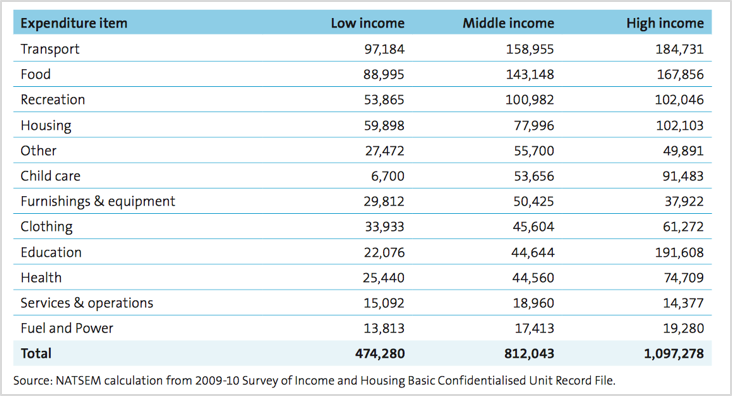

Figure 3: Lifetime shopping bill for two children from birth until they finish their education.

The main differences between income groups stem from Education, Childcare, Healthcare and Transportation. Education is the biggest gap, with $170k of greater expense for a high-income family than a low-income family (likely even greater for most people).

In summary, with adjustments for the Australian dollar, Australian cost of living and the cost of raising a child, the total presented by Gladwell moves from $75,000 USD to $110,000 AUD. So there is a difference, but it’s marginal.

I can’t genuinely accept that correlation

Malcolm Gladwell is a great writer; he captures the science simply alongside compelling anecdotes, so it’s easy to go along with his arguments without exerting too much critical thinking. One of the main data points that he draws upon is the correlation between happiness and wealth. He points to the research which demonstrates that when you reach a certain level of wealth, your happiness plateaus.

In actual fact, the research here is a little more complex than the parallels Gladwell draws. Daniel Kahneman and Angus Deaton studied 450,000 people against two types of subjective well being – emotional and life evaluation.[4]

  • Emotional: the quality of everyday experience – the frequency and intensity of joy, stress, sadness, anger and affection that makes one’s life pleasant or unpleasant.
  • Life Evaluation: thoughts people have about their life when they reflect on it.

Life evaluation rises with income. When we pause and reflect, people with greater financial resources feel happier. Emotional wellbeing on the other hand rises with income, but there is no further progress beyond an annual income of $75,000 USD.

Gladwell could argue (he doesn’t do so explicitly) that emotional wellbeing dictates parenting ability, and that day-to-day emotional wellbeing is the critical component. I might add that patience, if it is considered emotional wellbeing, is close to the top of the list.

Let’s assume that the relationship between wealth and emotional wellbeing explains the first half of the U curve and the plateau. This doesn’t account for the challenge as wealth increases. This is the pivotal component. Why does parenting become harder as wealth increases?

The psychologist James Grubman explains the second half of the curve: ‘A parent has to set limits. But that’s one of the most difficult things when you don’t have the excuse of, “we can’t afford it, it’s gone”. “No we won’t” is much harder. “No we can’t” is simple. You have to say, “Yes, I can buy that for you. But I choose not to”. It’s not consistent with our values. But that requires that you have a set of values, know how to articulate them, and know how to make them plausible to your child. All of which are really difficult things for anyone to do.’[5]

This argument resonates with our experiences working with families. As well as helping facilitate the conversations Grubman describes, focusing on values is powerful because it helps a family appreciate how much it has in common.

Still don’t believe it?

It is important to remember Gladwell focuses on just one part of being a parent – instilling the value of money and the meaning of work.

It is no more heartening when we turn to empirical studies by Suniya S. Luthar which demonstrate that the challenge for wealthy children is not just constrained to finding the joy and fulfilment that comes from making their own way in the world. Luthar reports that ‘wealthier children tend to be more distressed than lower-income kids, and are at high risk for anxiety, depression, substance abuse, eating disorders, cheating and stealing. Compared to National rates, boys and girls from families with an income greater than $150k have serious levels of depression, anxiety, or somatic symptoms twice as often or more.’[6]

Conclusion

The correlation we have examined here may be negligible between our Australian tipping point of $110k and a family income of say $250k. After all, the curve arches away slowly as the wealth axis increases. At the same time, greater wealth does bring greater challenges; it is something we witness firsthand.

For families where wealth is a new phenomenon, and for parents who didn’t necessarily strive to be ‘rich’, these challenges can be greater. Families with a history of successfully transferring wealth between generations often have a set of family norms that help to nurture stewardship. Parents who are new to wealth may not naturally have the skills or experience to manage the transition for their children.

Many of us live in a certain bubble that insulates us from the national or global reality of our status, with a confirmation bias that filters out arguments such as these. It is important therefore to reflect on whether we might benefit from a slightly different tack with our children, even if the challenges are not immediately obvious day-to-day, and if the statistics in front of us are a little inconvenient.


[1] Malcolm Gladwell, David and Goliath, 2014
[2] Ibid.
[3] 11% is calculated by combining the average of the following data points:
– Consumer price index including rent (6% higher in Australia)
– Restaurant prices (11.57% higher in Australia)
– Purchasing-power parity from the Economist Big Mac index (14.6% lower in Australia)

[4] Daniel Kahneman, Angus Deaton: ‘High income improves evaluation of life, but not emotional wellbeing’, 2010
[5] Malcolm Gladwell, David and Goliath, 2014
[6] Suniya S. Luthar Ph.D. Psychology Today, June 2016


Family Goal Setting

The start of a New Year has always been a good time to think about what is ahead, and more importantly, what direction you want to take.

In our family, we’ve always shared New Year’s resolutions. At least, my mother would pressure us into having some and, subtly or not so subtly, suggest what they might be: ‘tidier’, ‘more helpful’ or ‘more independent’, perhaps.

What is your view on setting goals?

We’re not talking about the professional goals you quickly write (or copy from last year) into your annual performance review. We’re talking about your personal goals; the dreams you want to make a reality, like the person plotting the review of their new business idea.

  • I’m going to train twice a week so that I can compete in the September half-marathon.
  • I will dedicate two nights a month to connect one-on-one with my closest friends.

The actions that set apart people who set goals effectively and those who only manage to talk about their goals in vague terms are actually quite minimal.

How many people do you know who do all four of these things?

They sit down and write what they are going to achieve and when, they can articulate what success looks like, they quantify it and, either before or after they have done so, they discuss it with the people closest to them for feedback and support. I’m betting you don’t know that many.

The amount of work to get from the thing we pretty much all do – chat to the people around us about where we are going and what we want to achieve – is minimal, but when we have to put our minds to it and write our goals down, the drop-off is phenomenal. Why is this?

Let’s start by considering the question our 3-year-old daughter asks us when proposing we go to the park: ‘Does that sound like fun?’

No, it would be a big stretch to call goal-setting fun. There’s probably no better way to kill the buzz of the New Year than being forced to get specific on the flash of inspiration you had on your morning swim, or worse, unpacking those ideas you’ve been threatening to do for a long time. It can be unsettling to push yourself to articulate how you will truly achieve something, even though this process will bring you closer to it.

We make ourselves immediately unpopular with the families we work with, because we get them to do all of these steps. Even worse, we get them to keep working the goals based on feedback from their family and then we get them to come back to the goals they set, to see what lessons they can learn.

As outsiders, we have an advantage that allows us to be so dogmatic. In our podcast series, we interviewed a family that had been through our goal-setting process. The adult children spelled out the difference between the well-intentioned advice of a family member and non-family guidance quite succinctly:

‘It’s good to have someone who’s not family, who can make you feel accountable for stuff. You know, when I say I’m going to do something, and I don’t, and you can pull me up on it, that’s really good. But if that was one of my parents, it might not be received so well.’

That final point might have been an understatement. One of the main reasons we hesitate when sharing our hopes and dreams with our families is that family doesn’t have to reach very far to find a couple of lines that can, to put it nicely, ground us. After all, they have so many examples of where we didn’t follow through on our commitments. All parents have numerous examples of their children’s lost goals – whether it’s an abandoned hobby or a neglected pet.

We don’t have to look very far then to see why we don’t work our goals through properly, let alone in a family context. It can be an unenjoyable process; it will certainly unsettle us and can quickly create conflict.

Leaving this aside, for those who push past these challenges, the rewards are significant. It’s something we explored with our interviewees:

‘I feel like I may be closer to working out what’s possible for myself, and what I can actually achieve, especially with the support and help and the skill sets of people around me. By constantly sharing and updating the kinds of dreams and goals in a shared conversation, I feel like I am closer to developing what I actually want my dreams to be.’

Let’s just pause on that last line: ‘I’m closer to developing what I actually want my dreams to be.’ That is an astounding achievement.

What we might usually expect to hear in the benefits column are things like ‘I achieved what I set out to’ or ‘I wrote down what I wanted to achieve and 12 months later it happened’. But this isn’t ‘The Secret’. Our lives are infinitely more complex and non-linear.

What this shows is that repetitive goal setting forces you to work out what you want. You might not get it right the first time, but as you take the time to re-visit the goals, you have to refine what feels right. After sitting down with five people to review your business plan, when you get into the details of what is required, are you more passionate about that venture; that path you set for yourself?

You can start to achieve this if you revisit your goals regularly by yourself. However, the process of articulating and sharing your goals is the critical step in keeping yourself honest. The reason family is such a liability is the same reason it is such an asset. We know our families will call us out on something that doesn’t sound like an authentic goal. They uncover what’s new really quickly. Unsurprisingly, this was a topic of conversation that was well-articulated by the family:

‘To actually sit there in a workshop with a group of people who understand where you’re coming from with those goals is really useful. It’s really valuable to have the family’s advice and help.’

The final part here is critical. Having the family share in goal setting makes it is easier to understand where the family resources can be useful.

The holidays can be a challenging time of year in our house. Like many, we constantly play the game of whether we should tell each other what we want to receive. It’s the balance between ensuring we get what we want, and the magic of picking the right thing. For a small gift, this isn’t a big deal. For a family considering how to use its resources to help its members achieve their goals, it is far more significant. You need to know exactly what people want to achieve and how they want to get there before you can think about how you can help.

Let’s assume the business plan is refined, the experiment is a success and the new venture needs significant resources to be successful. It would be easy for family members to jump in with the capital. But what if the individual had a new goal, to understand in a very real, practical way, how venture capital works. A gift of directly funding the project would actually be an impediment. We only find these things out when we ask the right questions and get a deeper understanding of each other’s ambitions.

This brings us to the final point. By exploring goals with your family, it is much easier to see how you can put your non-financial resources to use; a phone call once a week to keep someone accountable, coaching on how to sail, an audience for a dry-run of a public speaking engagement. These gifts are much easier to identify when we share our goals. They can become the most powerful gifts, creating long-lasting experiences and the potential to bring family members closer together.

Successful goal setting is dependent on a safe environment that encourages people to share – something to consider as your family contemplates its New Year’s resolutions.


Holistic Model for Stewardship

We are often asked how a focus on family and the non-financials integrates with traditional wealth advisory roles. Put simply, it is all about the human and intellectual capital. We see these elements as the essence of the family office and the basis for all the subsequent activities a family pursues.

For many people this still raises a series of questions, in particular what problems this family component is trying to solve and how it fits with the existing advisers supporting the family. As a way of clarifying the relationships with traditional wealth, legal and accounting roles, we developed the following model:


Figure 1: A holistic model for stewardship

In many respects, the process of engaging advisers would be smoother if a family started by defining its values, purpose and strategy, then focused on creating a foundation of strong governance and clear protocols with an empowered, harmonious, educated family unit. This of course assumes a level of organisation that most families may not know how to get started, even with a picture of the future in mind. Instead, let’s consider the organic development of a family and how the support of advisers follows a natural cycle of challenges and priorities.

At the start, families are often faced with transactional safeguards and structural problems to solve, for example, to complete a complex tax return, draw up a Will or create an ownership agreement.

In response, families often engage an accountant or a lawyer. As resources grow they may seek wealth advice, which could include experts in philanthropy, financial planning or asset protection. As a result, alongside hard work and good fortune, the first phase in the cycle emerges – prosperity.

1. Prosperity

The wealth created within a family is typically structured with the goal of sustaining a level of prosperity. Often, this will be aligned to the needs of the existing family leaders; to the interests and ambitions of the original wealth creator. As a result, it is rare for existing advisers to have significant contact with the broader family or the next generation. Communication is focused on the family patriarch or matriarch.

Significant life or liquidity events often compel families to think more deeply about what it means to be wealthy and the impact of the prosperity they have created.

Life Events Liquidity Events
Retirement Wills
Marriage / Divorce Estate Planning
Ageing / Mortality Succession Planning
Lifestyle / Poor health Sale of a Business
Birth / Death IPO

Figure 2: Life and Liquidity Triggers

These triggers bring a focus on estate planning, portfolio management and asset protection through trusts and other vehicles. In turn, this can force a family to consider the dynamics and relationships, raising important questions:

  • What can I do to help my family make well-informed decisions?
  • How do I determine what is too much to inherit?
  • How can I avoid entitlement?
  • Am I confident that my children have the capability to sustain the family resources?

Answering these questions regularly shines a light on family dynamics, the readiness of the next generation and the risk of potential conflict in the family.

2. Harmony

The immediate goal in this phase is harmony. Supporting the family to re-balance and re-align to the new reality of additional wealth or transitional wealth between generations. This is where the family dynamics in the top circle emerge as a central theme.

Our role therefore starts by addressing a need for family harmony, something that can only be achieved through open, honest communication. Creating shared values, purpose and strategy helps families become more stable and aligned. Some families need to have the tough conversations about conflict, entitlement or successors.

Conversations back around the kitchen table provide an opportunity for family members to share their hopes, ambitions and goals, to impart wisdom and build a shared family story. These discussions can be used to help build a respectful and productive governance model; a guidebook that shapes interactions and protocols for the future.

Deeper conversations about wealth, what it means and how the resources can be utilised move the family towards an additional goal: new opportunities.

3. Opportunity

Once the intent of family leaders to put existing family resources to use for future generations becomes clear, the conversation shifts towards what can be achieved. This is an exciting, hopeful conversation. What are the driving goals and ambitions of future generations, and how can the resources within the family be used to support these goals? How can future leaders impact business and society?

To deliver these opportunities, family members have to address their individual education needs and gaps. This is where traditional family advisers can play an important role; for example, educating and guiding the broader family in the structure of the family assets and decision-making processes.

4. Stewardship

The final challenge is for family members to look beyond themselves and focus on stewarding resources for future generations. To do this successfully, all three parts of the model need to work together. The family needs to grow and sustain its wealth and resources. It needs to be structured appropriately with the growth and development of human and intellectual capital.

To facilitate stewardship, advisers need to work together, to share information and bring that transparency to the family. Communication models change in this regard. Strategy is driven by the family and owned by future generations. Advisers are brought in to solve specific technical challenges, individually and in an open forum.

5. Family Patterns

Not every family will follow a path in the order described here, nor will they need every element within the three circles. Each family will have different objectives and timelines. Generally though, it is hard to achieve stewardship without a combination of the three circles and without advisers across these three areas working together. The model also assumes the family has a progressive view of wealth. And it is dependent on a desire to maximise the human and intellectual capital in the family. You can read more about this shift in the article From Ownership to Stewardship

We believe in using specialist advisers for specialist activities, targeting advice to specific problems. Our advice around the non-financials integrates with traditional wealth advisory roles. It is a complement to the existing advisers that may be supporting a family.


From Ownership to Stewardship

Unprepared children can erode family resources far quicker than poor wealth management. Yet we continue to value traditional measures of asset protection over the readiness of our children to lead our families and steward the wealth.

Over the past few years, we’ve begun to see a shift. This old model of ownership is being replaced by a new model of stewardship. The table below captures this transition:

Old Model – Ownership New Model – Stewardship
Protecting the assets Putting assets to use
Financial capital Human and intellectual capital
External governance Self governance
Limited information sharing Transparency of information
Limited decision making Collaborative decision making
Education by external institution Education tailored to each individual
Profits Profit with purpose
Assets transferred after death Assets shared when alive

Figure 1: From Ownership to Stewardship

This new model is central to our philosophy. As a result, I’ve been examining these ideas with different families and family advisers and have recorded some of these conversations in the podcast series ‘At the Kitchen Table’. A good example of the difference between the old way and the new way was in my first interview, with my father.

My family story goes back six generations, and our history links to the Lousiana purchase. I picked up the story with Dad when he became the executor of my grandmother’s estate. What I learned through this conversation was that the strategy and overriding focus passed down from his father was tax effectiveness. The purpose for my father was to split the assets (which included businesses, trailer parks in Washington and land in Louisiana) and give each sibling their own share as efficiently as possible. There was no consideration given to the enduring legacy of the wealth into future generations.

Imagine what could have been achieved if my family had worked together and stewarded that wealth. My Uncles and Aunts are all pilots and teachers, yet the potential conflict and the tax implications won over. My Dad believed the worst outcome was to attempt to make decisions by committee.

As a juxtaposition to this story, the new way appreciates the human and intellectual capital and the rewards that come from putting assets to use as a family. It takes some work: a commitment to push through tough situations and a structure that respects everyone’s unique strengths and ambitions. If this can be achieved, it sets up a self-governing process that can be richly rewarding for the family members involved. It can sustain the values of the family, bring the family together and encourage collaboration.

There is also a growing movement amongst the new generation on social consciousness. This is manifested in a shift from family responsibility (providing for my family) to social responsibility (giving back to society).

The new way focuses on putting wisdom and wealth to use in order to maximise the human and intellectual capital in the family. It also acknowledges that while institutional learning has its merits, there are certain elements of leadership development and financial literacy that need to be personalised in the context of the family and the individual. The best corporate learning programs integrate coaching with traditional learning mechanisms.

The new way accepts the past as it is and shifts the family’s focus to the present and future generations. It is about creating situations that allow families to work together right away rather than wait for the loss of a loved one, a familly crisis or some other life event. It encourages families to look at the resources within the family and examine how they can be used now. It asks wealth creators to experience and guide the transition of assets so they are able to enjoy the process and contribute in a meaningful way.

Which way is your family going?


Podcast Episode 4 – At The Kitchen Table With The Next Generation

Herding Cattle…

A very special family I’ve been working with closely, held their Family Council meeting in Bondi this week, which was a great opportunity to sit down with the next generation of the family.

Here we have 3 bright, thoughtful young adults reflecting on the past two years of experiences, challenges and successes in the development of their family office. In this discussion we considered goal setting in a family context, values, philanthropy and family dynamics. This episode gets to the core of our process and captures many insights for families considering this work.

Listen to the episode below:


We need to talk about the wealth…

10 year old Jamie Johnson discovered just how wealthy his family was when a classmate found his Dad’s name in a Forbes magazine article listing the 400 richest people in America.

In the documentary ‘Born Rich, Children of the Insanely Wealthy’ the Johnson and Johnson heir describes how the article was then read aloud, with Jamie, his teacher and the rest of his class listening on intently.

In the same documentary, Josiah Hornblower, a Vanderbilt / Whitney heir, described the day his uncle took him on a tour of New York, from Grand Central Station, to the Whitney museum and beyond, pointing out all the prominent buildings the family owned. Until that point he had a basic upbringing with no appreciation for the wealth in the family.

The examples here are exaggerated; few children come from families with their own museum, however, they still impart valuable lessons.

In both scenarios, despite the best efforts of the parents to conceal their wealth the children invariably found out. By failing to own and shape the conversation, the parents, in effect abdicated this responsibility and others stepped into the vacuum, creating an abrupt, life-altering experience for their children.

We should not be surprised by these examples. The Wall Street Journal reported that only a third of parents worth more than $20 million discussed wealth with their kids before they turned 21.

Why is wealth so difficult to talk about in families?

A common argument goes like this… Why would our 15 year old focus on schoolwork and passing exams, charting their own path, if they find out that the family is worth $100Million? Furthermore, why burden them with all the extra pressure so young.

Parents are often nervous about creating a sense of entitlement and lack of ambition among their children. These are valid and real concerns. However, there are some flaws in connecting these concerns directly to the conversation about family resources.

First of all, a 15 year old probably has a good idea that there is wealth in the family and if you don’t talk about it, your children will make their own assumptions. These assumptions are rarely accurate.

Secondly, the family wealth doesn’t always connect to inheritance. It is important to talk about how the strategy and purpose behind the family wealth relates to your estate plans. It may be that the family resources are illiquid and tied up in a business.

In the worse case scenario should your children suddenly inherit wealth they were unprepared for, rather than protecting your children, you could be setting them up for failure.

By starting early and often, you have a much better chance of moving the conversation in a positive direction, which returns to our core philosophy and redefining what it means to be wealthy.

With this philosophy in mind, here are our top five recommendations for talking about your family resources:

1. It’s not about the money

This advice sounds counter-intuitive but the goal is not simply to make your family aware of the resources available, it is to help them see those resources as a means to support activities that bring personal meaning and purpose.

Rather than structuring interactions around the money, see this as an opportunity to start a more progressive, holistic conversation.

Introducing the concept of stewardship, purpose and meaning alongside the wealth, sets the expectation that they go hand in hand. Talking about the family history at the same time creates an opportunity to integrate lessons around values and work ethic.

2. Don’t feel as though you need to have all the answers

These conversations can often be confronting because they open up questions that you may not be fully ready to answer.

What is your personal purpose and strategy for the resources in your family?

The example that parents set is fundamental to the process. It’s hard to expect your children to become confident stewards if you don’t demonstrate the same philosophy.

However, setting this up as a one-way conversation immediately undermines the confidence you are hoping to instil. If you start the process as a blank canvas that the family can shape together, you are more likely to have a meaningful and engaging conversation.

These conversations can be the first step in shaping the next chapter in your family story.

3. Make it a progressive family discussion

Our focus here is on the children, but fundamentally, this is a discussion involving the whole family, an opportunity to ensure everyone has a shared understanding. It is surprising how many spouses lack insight into the structure and composition of the family resources. This is sometimes as simple as knowing where the account passwords are kept.

Making the conversation a family conversation, takes the pressure off the children. It’s no longer a big deal, or focused on one individual, it’s something that the family does collectively.

4. Get help

If your child were struggling with their homework, you wouldn’t question the idea of getting a tutor, yet we often hesitate when it comes to financial education and sensitive topics like the family resources.

The truth is, for all of the influence we have over our children’s lives, when we assume the role of teacher our children often react negatively or switch off.

You can use these conversations to shape your families approach to wealth and to set the goal of creating confident stewards. If you don’t start the conversation it’s impossible to articulate or reach this goal. But to execute this goal, get the right the help.

5. Start the conversation today

Watching the remainder of the ‘Born Rich’ documentary it becomes clear that the experience Jamie had that day at school didn’t trigger a wave of transparency in the Johnson family. Accepting the fact he’s on camera, the questions Jamie poses to his Dad about the wealth in the family is an excruciating experience; it captures just how uncomfortable the topic becomes when it is so rarely spoken about.

Don’t fall into that trap. The earlier you start, the more you talk about it, the easier it becomes. Start small and build from there.

Remember it is a conversation not a presentation, don’t over-engineer it, but think about what will work best for your family.

Start the conversation when people are ready, open and together and kick off with some open questions. You might be surprised what your family already knows or believes.